What makes Cedar Hill soil hard on concrete
Cedar Hill sits on the White Rock Escarpment, where the ground changes fast from one lot to the next. Some yards have shallow Austin Chalk limestone. Others sit on Eagle Ford shale or deep, dark Blackland clay. The clay is the troublemaker. It can swell a lot in volume when it soaks up water and shrink back with deep cracks in a dry August.
A slab on that soil gets pushed up in wet months and loses support in dry ones. If one side of the slab stays wetter than the other, say near a downspout or a flower bed, that side moves more. Uneven movement is what cracks concrete.
Base prep comes first
Let's break it down. A good slab starts by stripping the topsoil and organic material, which compresses and rots. Then the crew grades and compacts the subgrade so it is firm and even. On top of that goes a layer of crushed rock or select fill, compacted in lifts.
That base spreads the load, gives water a path out, and keeps the slab off the most active clay. For bigger slabs and concrete foundations, an engineer may call for removing and replacing some of the clay, or for moisture conditioning before the pour. Skipping base work saves money on day one and costs it back many times over.
Control moisture around the slab
Here is why moisture matters as much as concrete strength. Clay that stays at a steady moisture level moves far less. The goal is to keep water from pooling at the edge of the slab in spring, and to keep the soil from drying out and pulling away in summer.
A few habits go a long way.
- Slope the ground away from the slab, at least a few inches over the first several feet.
- Run downspouts well past the edge of any slab or patio.
- Keep trees with thirsty roots a good distance from foundations and slabs.
- Water evenly around the house during long droughts instead of letting one side dry out.
- Seal joints and cracks so rain cannot soak the clay under the slab.
Joints, rebar, and post-tension
All concrete shrinks as it cures, and on clay it also gets pushed around. Control joints are planned weak lines that give the slab a place to crack neatly. A rule many crews follow is to space joints no more than two to three times the slab thickness in feet. A four-inch slab gets joints about every 8 to 12 feet.
Square-ish panels crack less than long skinny ones. Joints should be cut or tooled to about a quarter of the slab depth, and saw cuts should go in soon after the pour, before the slab cracks on its own. Isolation joints separate the slab from the house, posts, and other fixed things so each can move on its own.
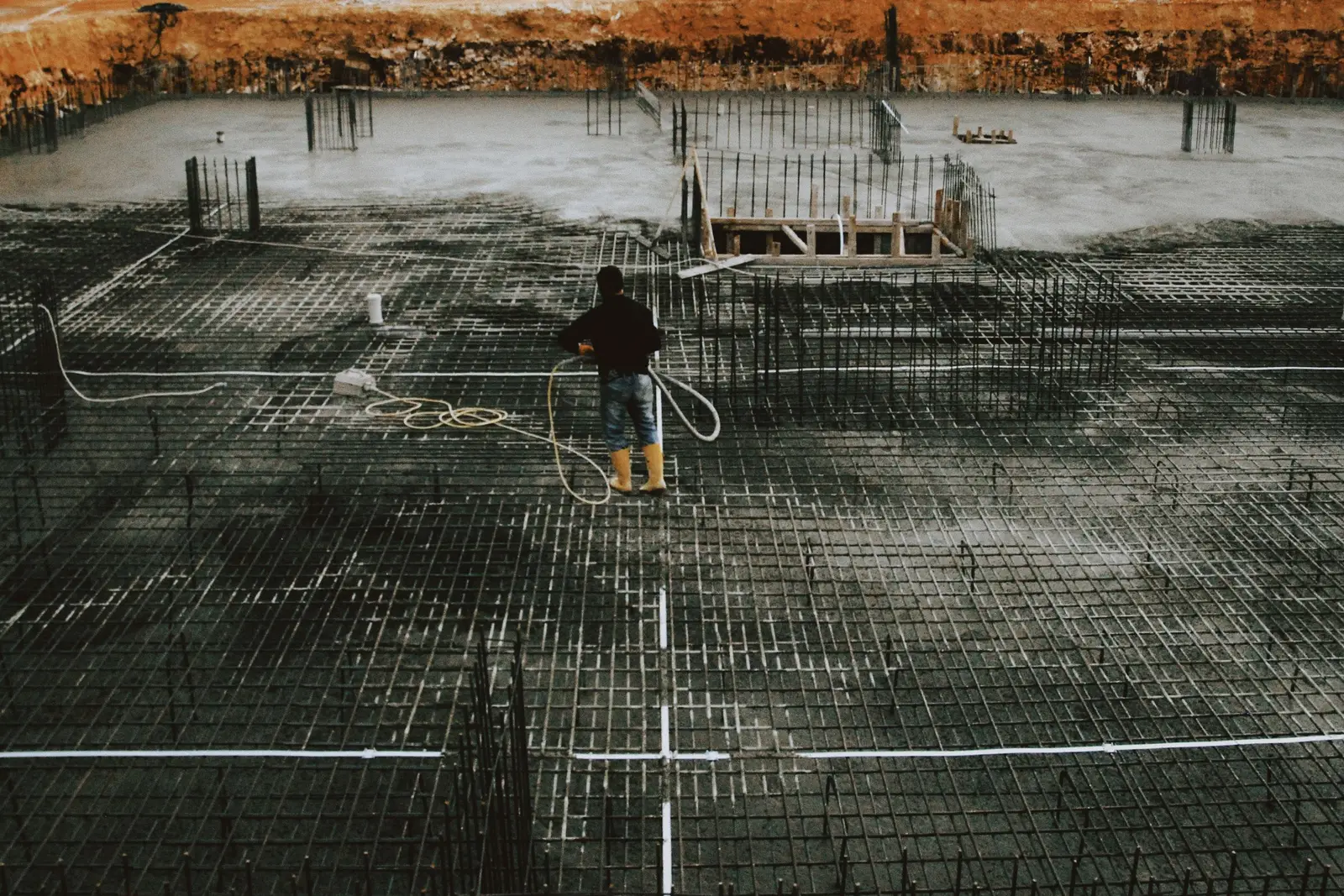
Steel does not stop concrete from cracking. It holds the cracks tight so the pieces stay level. Rebar on a grid, set on chairs at mid-depth, is the common choice for driveways and concrete slabs on clay. Wire mesh can work on light-duty slabs, but it often gets stepped down to the dirt during the pour, where it does little good. Post-tension is a different system used for many house foundations in North Texas. Steel cables run through the slab and get tightened after the concrete cures, squeezing the slab together so it acts as one stiff unit. It is engineered work for foundations, not something you need for a patio. If you are building a home or shop, your engineer will spec the system. Thickness matters as well. Four inches suits patios and walks. Driveways that see trucks, and slabs under heavy loads, often go to five or six inches with thickened edges. A thicker slab spreads the load wider and bridges small soft spots better on moving clay.
What good prep looks like on pour day
You cannot see the base once the concrete is down, so watch the job before the pour. Here is what good prep looks like.
- Topsoil and roots stripped down to firm ground.
- Base rock spread and compacted in layers, not dumped and smoothed over.
- Steel tied in a grid and set on chairs or blocks, not lying in the dirt.
- Forms set to a grade that sheds water away from the house.
- A plan for joints and curing that the crew can explain in plain words.
What to ask a contractor
If you see the base going in dry and loose, or steel sitting on the ground, ask about it before the truck shows up. It is far easier to fix then than after the pour.
Next steps: before you hire anyone for slab work on clay, get clear answers to these questions.
- How deep will you excavate, and what goes in the base?
- How will you compact the base, and in how many lifts?
- What steel will you use, how is it spaced, and how will you keep it at mid-depth?
- Where will the control joints go, and when will you cut them?
- Which way will water drain off the slab?
- How will you cure the concrete in our heat?
When a slab has already moved
If a slab has sunk or tipped but is still in one piece, concrete leveling can lift it back into place by filling the void underneath. Fix the water problem that caused the drop at the same time. If the slab is broken up across most of its surface, replacing it with proper base work is the lasting answer. Request a free estimate or call (469) 402-4525 and our crew will look at the soil and the slab.
Common questions
Why does concrete crack so much in Cedar Hill?
Expansive Blackland clay swells when wet and shrinks when dry. A slab on that soil moves up and down with the seasons, and uneven movement causes cracks. Good base prep, joints, and steady moisture cut that movement down.
Is rebar better than wire mesh on clay soil?
For driveways and slabs on clay, rebar on a grid set at mid-depth is usually the better choice. It stays in place during the pour and holds cracks tighter. Mesh can work for light-duty slabs if it is kept up off the ground.
Do I need post-tension for a patio or driveway?
No. Post-tension is an engineered system mostly used for house foundations. Patios and driveways rely on base prep, rebar, joints, and drainage. Ask your engineer about post-tension if you are building a home or large shop.
Can I stop clay from moving under my slab?
You cannot stop clay from moving, but you can make the movement smaller and more even. Keep water draining away, seal joints, water evenly in droughts, and keep big trees back from the slab.